

How shared container shipping works in 2026 — racking, consolidation at Felixstowe, costs, transit and the right routes for groupage.
What groupage / shared container shipping is
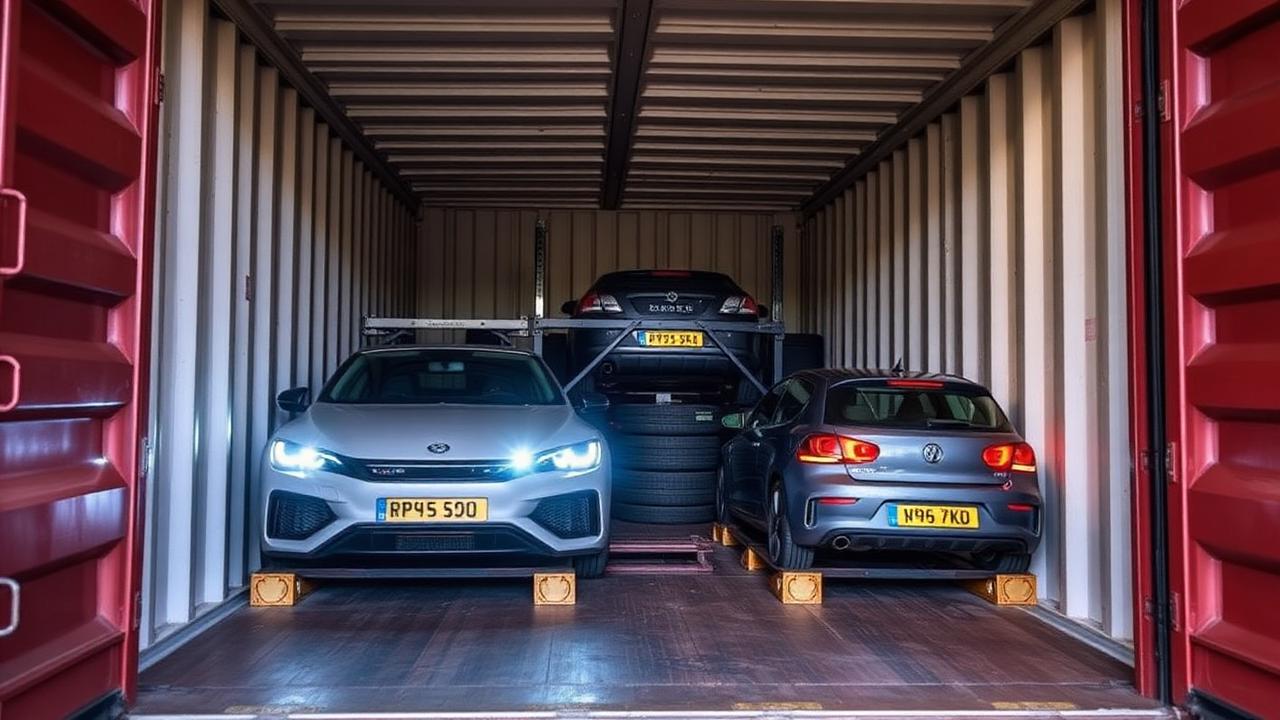
Shared container shipping splits a 40ft high-cube between 3–4 cars using purpose-built racking. The vehicle is sealed inside, personal effects are allowed and the cost sits between RORO and a dedicated 20ft. See the wider shared container service and the master groupage guide.
How loading works at Felixstowe
Cars are accepted at our Felixstowe consolidation point on the booked sailing week. Wheels are chocked, racking is bolted and the container is sealed in the customer's presence. Photos go on the file alongside the Bill of Lading.
2026 costs and best routes
Shared container Felixstowe to Jebel Ali from £1,750, to Lagos from £1,650, to New York from £2,100, to Sydney from £2,650. Lanes with frequent consolidation give the lowest price — see the regional pages for Middle East, Africa, Europe and USA & Australia.
When groupage is the right call
Choose shared container when you need enclosed protection without paying for a full container, when personal effects must travel with the car, or when the destination port lacks reliable RORO service. Get a free WhatsApp quote on 01482 228366 or use our instant cost calculator. Ship Cars RoRo has shipped vehicles to 50+ countries with full marine insurance and door-to-port handling.
How racking and securing actually work
Modern shared-container racking is engineered for 3–4 vehicles inside a 40ft high-cube. The first car loads at the rear (the back of the container becomes the front because container doors are at the rear), driven onto a steel rack that lifts the front wheels above floor level. The second car then loads under the lifted rack, the third on a mid-rack and the fourth on the floor. Wheels are chocked with timber, axles are lashed to D-rings with ratchet straps and soft-strap nets protect any classic that needs body-panel-free securing. Internal CCTV records every loading sequence on our Felixstowe consolidation site and the footage is held for 90 days. The result is enclosed, immobile and traceable transport at a price well under dedicated FCL.
What to put in (and keep out of) a shared container
Shared container shipping is one of the few UK car export channels where personal effects are permitted, but the rules are strict. Allowed: boxed clothing, books, toys, kitchenware, sealed tools, bicycles, baby gear, vacuum-packed bedding and similar dry household items, declared on the packing list and totalling under 100 kg per vehicle. Not allowed: fuel, batteries (over the one in the car), aerosols, perishables, weapons, alcohol over duty-free limits, lithium batteries above the carrier's threshold, and any prohibited goods on the destination country's list. Anything packed must be inside the car or in clearly-tagged boxes inside the rack frame. Random destination customs inspections do happen — undeclared items cost the whole container delay, not just yours.
Consolidation cycles and how lead time really works
Groupage runs on a consolidation cycle: the cargo manager waits until the container is profitable to ship, then closes booking and loads. On major lanes — UK to Jebel Ali, UK to Lagos, UK to New York, UK to Sydney — a fresh container closes every 7–14 days. On thinner lanes (UK to Trinidad, UK to Suriname) it can be 21–35 days. Real lead time for a customer is therefore: 1–7 days waiting for consolidation, 1 day loading, then the published transit. We publish the next two consolidation dates per lane on enquiry so customers can plan. If a deadline is tight, dedicated container ships immediately and can be cheaper net-of-time than waiting two weeks for groupage.
Costs — what shifts the price up or down
Shared-container freight in 2026 is driven by four levers: lane (UK to Sydney costs more than UK to Lagos), vehicle cubic metres (a tall SUV displaces more rack space than a saloon, so price rises 15–25%), special handling (low-clearance or non-running vehicles cost extra to load), and timing (peak-season Q3 surcharges add 8–12%). Our standard shared container rate is per vehicle, not per cubic metre, which keeps quotations predictable for customers. A motorbike sharing rack space with a car ships for roughly 40% of the car price; two bikes can share a single car slot.
When NOT to choose shared container
Despite its strengths, groupage is the wrong call in three scenarios. First, when total shipment value justifies sole-use security — a £100,000+ classic or supercar should travel dedicated. Second, when timing is critical and the next consolidation is more than 10 days away — RORO usually sails sooner. Third, when destination port handling fees on container are much higher than on RORO at the same port (some West African ports are an example). For a balanced decision see our shared vs dedicated container comparison and the RORO vs container guide.
Insurance specifics for shared container shipments
Marine insurance on shared container is slightly more nuanced than on RORO or dedicated container. The recommended structure is all-risks (Institute Cargo Clauses A) at 2.5–3% of agreed value per vehicle, with a 'general average' contribution allowance for shared-container scenarios. General average means if the carrier sacrifices cargo to save the vessel (rare but legal), all cargo owners contribute proportionally — your insurance should cover this. Personal effects shipped alongside the car should be insured separately or added to the vehicle policy with an itemised list. Claims on shared containers typically resolve in 30–45 days under an all-risks cover, with the shared-container element having no material effect on claim outcomes provided each vehicle has its own photo file.
A real worked example — UK to Jebel Ali groupage
Take three customers sharing one 40ft high-cube Felixstowe to Jebel Ali in 2026: a £25,000 BMW X5 (slot 1, racked, top), a £18,000 Mercedes E-Class (slot 2, racked, middle), a £14,000 Toyota Land Cruiser (slot 3, floor). Total container freight £4,800. Each customer pays £1,750 (allocated by vehicle volume). Add £85 BAF per car, £125 terminal, £75 customs, £450 insurance on the X5, £350 on the E-Class, £280 on the Land Cruiser. UK-side totals: BMW £2,485, Mercedes £2,385, Land Cruiser £2,315. UAE-side duty and registration as worked above. All three cars share the same vessel, BL date and Jebel Ali clearance window, with personal effects allowed in each car up to 100 kg.
UK collection, recovery and onward transport
Before any international shipment, vehicles need to reach the loading port — and many customers ask us to handle the UK leg too. Our recovery and transport network covers every postcode, 24 hours a day.
Start with the main hubs: Car Recovery UK, Vehicle Recovery UK, 24/7 Breakdown Recovery and Nationwide Vehicle Transportation.
City coverage includes London, Birmingham, Manchester, Liverpool, Leeds, Glasgow, Sheffield and Bristol.
Pre-book a port run on a flatbed transporter from Southampton, Portsmouth, Liverpool or Felixstowe via Ipswich, or call 24/7 for breakdown recovery in London, Birmingham or Manchester.
Frequently Asked Questions
How many cars fit in a shared 40ft container?
Can I add personal effects in shared container shipping?
Ready to Ship Your Vehicle?
Get a free, no-obligation quote for international vehicle shipping from the UK. Check our destinations or use the cost calculator.
Written by
Zahir
SEO & Logistics Expert
Zahir is a seasoned SEO strategist and content writer specializing in international logistics, vehicle shipping, and automotive culture. With over a decade of experience in the shipping industry, he provides expert insights to help customers navigate the complexities of international vehicle transport.