

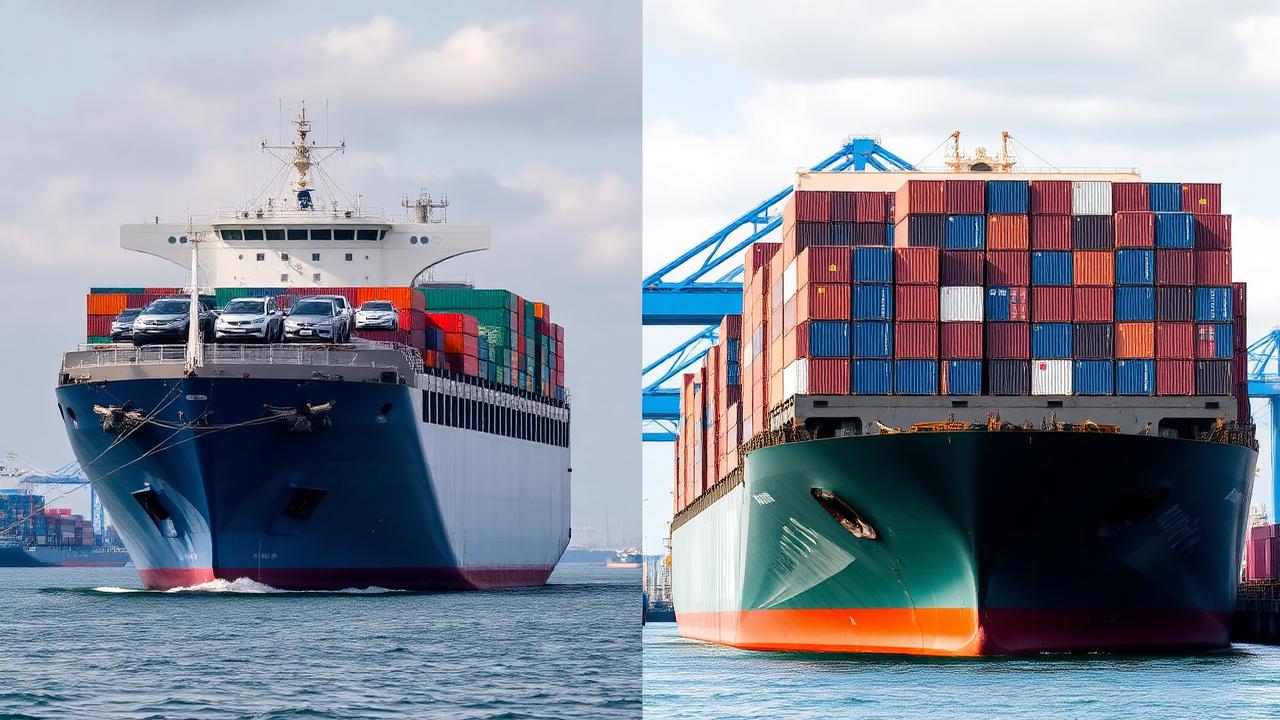
Side-by-side comparison of RORO and container shipping from the UK in 2026 — costs, transit, protection, FCL, LCL and shared container explained.
How each method works
RORO (Roll-on/Roll-off) vessels carry cars driven onto enclosed decks — see our RORO ship explainer. Container shipping seals vehicles inside 20ft or 40ft boxes, either as a dedicated container (FCL) or as part of a shared container (groupage / LCL).
Price comparison in 2026
RORO is the cheapest option, typically 30–50% under container on the same route — Southampton to Jebel Ali from £950 vs £1,750 shared container. FCL is highest, justified for high-value or non-runner vehicles. Use the cost calculator to compare for your destination.
Protection, schedules and eligibility
Container shipping seals the vehicle and allows personal effects; RORO is open-deck and bans personal items. RORO sails weekly on major routes — see the RORO schedule. Non-runners, modified or low-clearance cars require container. For high-value classics see our classic car shipping guide.
2026 decision matrix
Choose RORO for a clean, running saloon or SUV on a major lane with budget in mind. Choose shared container for mid-value cars where the £700–£1,000 premium buys full enclosure. Choose dedicated container for classics, EVs, modified cars or cargo above 100,000 GBP. Get a free WhatsApp quote on 01482 228366 or use our instant cost calculator. Ship Cars RoRo has shipped vehicles to 50+ countries with full marine insurance and door-to-port handling.
Transit time and reliability compared
RORO benefits from purpose-built PCTC (Pure Car and Truck Carrier) vessels operating on tight, published schedules. Southampton to Jebel Ali is 18–24 days, to Lagos 14–21, to Sydney 38–48 via Suez. Container sailings often involve transhipment at Algeciras, Singapore or Salalah, which adds 5–10 days but with more frequent departures from Felixstowe. Reliability data published by Drewry for 2025 puts RORO on-time performance at 78% across the major UK lanes versus 71% for container; both are strong by global ocean-freight standards. If a precise arrival date matters (a buyer waiting, a registration deadline), book RORO and ask for a confirmed voyage rather than a 'next sailing' allocation. For frequency-sensitive lanes such as UK to Cyprus or Malta where container leaves weekly but RORO only fortnightly, the container schedule can actually deliver sooner.
What you can and cannot do with personal effects
Personal effects are one of the most misunderstood differences. RORO strictly forbids any loose items inside the vehicle — including child seats, sat-nav units, dash cams, even floor mats are flagged in some terminals. Container shipping allows personal effects, typically up to 100 kg or one cubic metre, provided they are listed on a packing list and declared on the Bill of Lading. Restricted items remain restricted in both modes: no fuels, batteries (above the one fitted in the car), aerosols, perishables or prohibited goods. Dedicated FCL is the only realistic option for full household goods alongside the car. For more on permitted items see our UK export documents guide.
Damage risk, claims and what the data shows
Damage rates on managed UK car-shipping routes are low across both methods. PCTC operators report under 0.5% incident rate per vehicle on RORO, mostly minor dings during loading. Container damage rates are lower (under 0.2%) because the vehicle is enclosed and lashed. Where container loses ground is partial-loss claims arising from condensation, which can mark soft-top hoods and unwaxed chrome on long Far East lanes; desiccant bags and pre-shipment waxing manage this risk. Claim turnaround in 2026 averages 45 days on RORO with a P&I underwriter, 30 days on container under all-risks marine cover. Photographic evidence at both load and discharge is now mandatory — our team supplies a standard 12-photo report on every shipment.
Best method by vehicle type and value
A practical rule of thumb: under £20,000 standard saloon or SUV on a major lane — RORO; £20,000–£60,000 vehicle where enclosure adds peace of mind — shared container; over £60,000, classic, EV with high-voltage battery, modified or non-runner — dedicated container. Motorcycles, jet-skis and ATVs are usually crated then loaded in a shared container. Pickup trucks fit comfortably on RORO. Cars on air suspension that cannot be lowered must travel container because RORO ramps are too steep at low ride height. For an EV specifically, check the carrier's lithium-ion policy — most accept up to 50% state-of-charge on RORO in 2026.
How to book and what to expect next
Whichever method you choose, the booking sequence is the same: confirm quotation, pay 30% deposit, deliver the vehicle to Southampton (RORO) or Felixstowe (container), receive the inspection report and Bill of Lading once loaded, pay the balance, then track the vessel via the line's portal. Our team handles all customs filing on the UK side and hands the BL release instructions to your destination agent. Get a free WhatsApp quote on 01482 228366 or use the cost calculator to compare both methods side-by-side for your exact origin, destination and vehicle.
Environmental footprint and EV-specific considerations
RORO and container shipping have similar per-vehicle CO2 footprints on long lanes, since both run on the same bunker-fuel vessels. Container shipping is marginally lower per vehicle when the box is fully loaded with cars. For EV-specific exports in 2026, both methods are accepted but with conditions: RORO carriers require state of charge under 50%, no obvious cell damage and a written EV declaration. Container carriers are similar but allow higher SOC for shared groupage. Following the Felicity Ace and Fremantle Highway fires, every major carrier now monitors EV decks with thermal cameras and several require an additional EV surcharge of £80–£150. PHEVs face the same rules as full EVs. ICE vehicles continue to ship without restriction.
What our 2026 customer data shows
Across UK-origin shipments we handled in 2025–2026, 62% chose RORO, 28% chose shared container, 10% chose dedicated container. Lane-by-lane: UAE 71% RORO, Nigeria 58% RORO, Australia 81% RORO, USA 73% dedicated container (driven by classic-car imports under 25-year rule), Europe 84% RORO. Customer-reported satisfaction was 4.7/5 for RORO and 4.8/5 for container, with the slight container edge driven by personal-effects flexibility. Damage claims were 0.4% of RORO shipments and 0.2% of container — both well below industry norms. The clear takeaway: RORO is the default for standard cars on busy lanes, container wins for value-protected or personal-effects shipments.
UK collection, recovery and onward transport
Before any international shipment, vehicles need to reach the loading port — and many customers ask us to handle the UK leg too. Our recovery and transport network covers every postcode, 24 hours a day.
Start with the main hubs: Car Recovery UK, Vehicle Recovery UK, 24/7 Breakdown Recovery and Nationwide Vehicle Transportation.
City coverage includes London, Birmingham, Manchester, Liverpool, Leeds, Glasgow, Sheffield and Bristol.
Pre-book a port run on a flatbed transporter from Southampton, Portsmouth, Liverpool or Felixstowe via Ipswich, or call 24/7 for breakdown recovery in London, Birmingham or Manchester.
Frequently Asked Questions
Is RORO safe for new cars?
Can I put suitcases in the car with RORO?
Is shared container cheaper than FCL?
Ready to Ship Your Vehicle?
Get a free, no-obligation quote for international vehicle shipping from the UK. Check our destinations or use the cost calculator.
Written by
Zahir
SEO & Logistics Expert
Zahir is a seasoned SEO strategist and content writer specializing in international logistics, vehicle shipping, and automotive culture. With over a decade of experience in the shipping industry, he provides expert insights to help customers navigate the complexities of international vehicle transport.